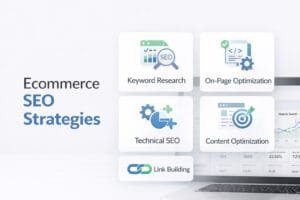
Relying solely on paid ads to drive ecommerce sales is no longer sustainable. As advertising costs climb and competition intensifies, ecommerce businesses need a steady flow of organic traffic to stay profitable. SEO isn’t just about ranking higher — it’s about attracting the right shoppers at the right moment in their buying journey. By optimizing your store with targeted SEO strategies, you can boost visibility, drive qualified traffic, and convert more visitors into paying customers.
Keyword Research for Ecommerce Pages
Effective ecommerce SEO starts with choosing the right keywords. The focus should be on commercial and transactional intent — the terms users search when they’re ready to buy.
Use tools like Ahrefs, Google Keyword Planner, or Ubersuggest to discover keywords with decent search volume and clear purchase intent (e.g., “buy wireless earbuds,” “best running shoes for women”). Avoid just targeting generic high-volume terms — they’re often too broad and competitive.
Create a keyword map that aligns specific keywords to your store’s:
- Homepage
- Category pages
- Product pages
- Blog content
Each page should target a unique set of keywords to avoid cannibalization and improve relevance for both users and search engines.
Site Architecture and Internal Linking
A clean and organized site structure helps both users and search engines navigate your store efficiently. Ideally, every product page should be accessible within three clicks from the homepage — this is known as a flat site structure, and it’s preferred over a deep, complicated hierarchy.
Use internal linking to guide users and search engine crawlers. For example:
- Link from category pages to best-selling products
- Use breadcrumb navigation for better UX and crawlability
- Add links from blog posts to relevant product or category pages
This not only distributes link equity across your site but also improves indexing and relevance signals for your most important pages.
On-Page SEO for Product and Category Pages
Every ecommerce page must be optimized with both users and search engines in mind. Start with the basics of on-page SEO:
- Title Tags & Meta Descriptions: Include your target keyword naturally. Keep titles under 60 characters and write compelling meta descriptions (under 160 characters) to increase click-through rates.
- Headers (H1, , H3): Use clear, keyword-rich headings to structure your content. Each product or category page should have one H1 tag and supporting subheaders as needed.
- Unique Product Descriptions: Avoid copying manufacturer descriptions. Write original content that highlights benefits, specifications, and use cases. Unique content improves both SEO and conversions.
- Image Optimization: Compress images to improve load times, use descriptive file names, and always include alt tags with relevant keywords.
- User-Generated Content: Allow customer reviews. They provide fresh content, help with long-tail keyword rankings, and build trust with potential buyers.
These on-page elements directly affect how well your product and category pages rank — and how well they convert visitors into buyers.
Technical SEO for Ecommerce Sites
Technical SEO ensures that search engines can crawl, index, and understand your website. Without a solid technical base, even the best content won’t rank.
Here’s what to prioritize:
- Mobile Responsiveness: Most ecommerce traffic comes from mobile. Use responsive design and test your site with Google’s Mobile-Friendly Test to ensure usability on all devices.
- Site Speed: A slow site kills conversions and rankings. Compress images, use a content delivery network (CDN), and minimize JavaScript to improve load times. Aim for a loading time under 2.5 seconds.
- Schema Markup: Use Product schema to display rich results in Google, like price, availability, and star ratings. This can boost your click-through rate significantly.
- Crawlability & Indexing: Submit your XML sitemap to Google Search Console and ensure your robots.txt file isn’t blocking important pages. Monitor crawl errors regularly and fix any 404s or redirect chains.
- HTTPS Security: SSL encryption is a ranking factor and essential for customer trust, especially in ecommerce.
A technically sound website improves visibility, trust, and user experience — all of which lead to higher organic sales.
Content Strategy for Ecommerce
Many ecommerce stores focus only on product listings — but content can drive serious organic traffic and influence purchase decisions.
Here’s how to build a content strategy that supports SEO and conversions:
- Blog Content for Buyer Intent: Create blog posts targeting informational and long-tail keywords. Focus on content that supports buying decisions, such as:
- “Best [product category] for [specific use case]”
- “How to choose the right [product]”
- Product comparisons and tutorials
- Buying Guides and How-Tos: These build trust and educate shoppers, positioning your store as an expert in the niche. Link to relevant product pages within the content to pass SEO value.
- Target Long-Tail Keywords: These are less competitive, more specific, and often have higher conversion rates. For example, “waterproof hiking boots for winter” instead of just “hiking boots.”
- Update and Optimize: Refresh older content with new data, updated links, and internal references to new products. Keep your content library relevant and optimized.
A strong content strategy not only boosts organic traffic but also helps guide potential buyers toward making a purchase on your site.
Link Building and Digital PR
Backlinks remain a major ranking factor. For ecommerce sites, getting quality links can help drive authority, improve rankings, and attract referral traffic.
Here’s how to approach link building effectively:
- Partner Outreach and Guest Posting: Collaborate with blogs or websites in your niche. Offer guest posts or partnerships that naturally include links back to relevant pages on your store.
- Influencer Mentions: Work with influencers to get product reviews or mentions on blogs, YouTube, or social media. These often lead to valuable backlinks and brand visibility.
- Digital PR Campaigns: Create newsworthy content like original studies, seasonal buying reports, or trend data. Pitch these to industry publications or journalists for coverage and links.
- Link-Worthy Assets: Publish resources that naturally earn links over time — such as comparison charts, calculators, or in-depth guides. These assets help build passive backlinks and boost topical authority.
- Avoid Spammy Tactics: Don’t buy links or participate in link exchanges. Focus on quality and relevance — even a few high-authority backlinks can outperform dozens of low-quality ones.
Strategic link building increases your domain authority, strengthens rankings for competitive keywords, and builds long-term SEO equity.
Measuring SEO Performance and Optimizing
To grow your ecommerce SEO effectively, you need to measure what’s working — and what’s not. Tracking the right metrics helps you make smarter decisions and improve ROI.
Here’s how to monitor and refine your strategy:
- Use the Right Tools:
- Google Analytics 4 (GA4) to track traffic sources, conversions, and user behavior
- Google Search Console (GSC) to monitor keyword rankings, click-through rates, and indexing issues
- SEO tools like Ahrefs, SEMrush, or Ubersuggest to audit your site and track backlink growth
- Set Up Ecommerce Tracking:
Enable enhanced ecommerce tracking in GA4 to see which pages and products drive the most sales, revenue, and engagement. This helps identify high-performing keywords and content. - Monitor Key Metrics:
Track organic traffic, bounce rate, average session duration, conversion rate, and revenue from organic channels. Look at both keyword-level and page-level performance. - A/B Test and Optimize:
Test different versions of meta descriptions, product descriptions, images, and layouts to improve click-through and conversion rates. SEO doesn’t end at rankings — it continues through the user journey. - Continuous Updates:
SEO is ongoing. Refresh outdated content, fix technical issues as they arise, and respond to algorithm updates to maintain and grow your rankings.
Measuring and adjusting ensures that your SEO efforts actually lead to real business results — like more sales and higher ROI.
Conclusion
Ecommerce SEO is more than just optimizing for search engines — it’s about connecting with customers at every stage of their buying journey. By focusing on smart keyword targeting, solid site architecture, technical performance, valuable content, and consistent link building, you can drive qualified traffic and boost your organic sales.
SEO isn’t a one-time task. It requires regular updates, monitoring, and optimization. But when done right, it creates a powerful and sustainable growth channel that doesn’t rely on paid ads. Start applying these strategies now to position your store for long-term success in 2026 and beyond.