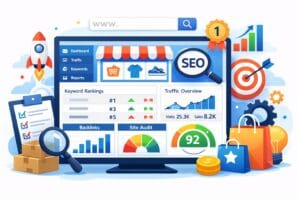
Search engines are one of the most powerful drivers of traffic for ecommerce websites. Yet, many online stores focus heavily on ads and social media while ignoring how effective SEO can be for long-term growth. Without proper optimization, even the best products can go undiscovered, buried beneath competitors who’ve nailed their SEO strategy.
Ecommerce SEO involves a mix of technical setup and content-driven tactics to help search engines crawl, index, and rank your product and category pages. From how fast your site loads to how well your product descriptions target search queries, every element matters. This post breaks down both technical and on-page SEO strategies that can help your ecommerce site rank higher, attract more organic traffic, and convert better — without relying solely on paid advertising.
Contact For eCommerce SEO/ Audit or FREE Help.

Hi, I’m Md Tangeer Mehedi — an eCommerce SEO expert.
I help online stores get more sales through Google Search and AI-powered results.
If your products aren’t ranking, you’re losing buyers.
Contact me and tell me about your store—I’ll show you how to fix it.
Why SEO Matters for Ecommerce Success
Unlike paid advertising, which stops delivering traffic the moment you stop spending, SEO offers sustainable growth. A well-optimized ecommerce site can rank for hundreds—or even thousands—of product-related keywords, drawing in qualified traffic every day without ongoing ad costs.
According to studies, nearly 44% of people start their online shopping journey with a Google search. That means if your products aren’t showing up in search results, you’re missing a huge chunk of potential customers. And it’s not just about visibility—organic traffic often has a higher intent to purchase, especially when search queries include specific product names or attributes.
Moreover, SEO improves user experience. Clean navigation, fast loading times, and relevant product content all support both search engine rankings and customer satisfaction. When users can quickly find what they’re looking for, bounce rates drop and conversions increase—two factors that also positively affect SEO.
If your ecommerce business relies only on ads or social platforms, you’re building on rented ground. SEO helps you own your traffic by making your store more discoverable, more usable, and more valuable over time.
Technical SEO Essentials for Ecommerce Sites
Site Structure & URL Hierarchy
A clear, logical site structure helps search engines crawl your site efficiently. Organize products into well-defined categories and subcategories. Use clean, descriptive URLs that follow a consistent format—avoid long strings of random characters or unnecessary parameters. For example:
/shoes/mens-running/ is better than /product?id=38492&cat=2.
Mobile Optimization & Core Web Vitals
Most ecommerce traffic now comes from mobile devices. Your site must be responsive and meet Google’s Core Web Vitals:
- Largest Contentful Paint (LCP): Measures load time
- First Input Delay (FID): Measures interactivity
- Cumulative Layout Shift (CLS): Measures visual stability
Use tools like Google PageSpeed Insights to test performance and fix issues.
Site Speed and Performance
Fast-loading pages are critical for both SEO and user experience. Optimize images, use lazy loading, reduce unnecessary scripts, and leverage browser caching. Consider a content delivery network (CDN) to speed up global delivery.
XML Sitemaps and Robots.txt
Submit an up-to-date XML sitemap through Google Search Console to guide search engines to your important pages. Use the robots.txt file to block irrelevant or duplicate pages (like filters or internal search results) from being indexed.
Crawlability and Indexing
Use Google Search Console to monitor how your pages are crawled and indexed. Fix crawl errors, eliminate broken links, and make sure important pages are not accidentally marked as “noindex.”
On-Page SEO Tips to Optimize Product & Category Pages
Keyword Targeting for Ecommerce
Every product and category page should target specific keywords based on how users search. Use tools like Google Keyword Planner, Ahrefs, or Ubersuggest to find long-tail keywords with buying intent (e.g., “leather hiking boots for men” instead of just “boots”). Avoid keyword stuffing—instead, integrate keywords naturally into page elements.
Title Tags, Meta Descriptions, and Headers
- Title Tags: Keep them under 60 characters and include the main keyword. Make them compelling enough to drive clicks.
- Meta Descriptions: Summarize the product or category in 155 characters. Include a call to action if possible.
- Headers (H1, ): Use only one H1 per page, usually the product or category name. Subheadings (s, H3s) can help break up content and include secondary keywords.
SEO-Friendly Product Descriptions
Generic or manufacturer-provided descriptions don’t help your rankings. Write original, helpful content that highlights product features, benefits, and use cases. Include relevant keywords without overloading them.
Image Optimization
- Use descriptive file names like
blue-running-shoes.jpg - Add alt text that describes the image for accessibility and SEO
- Compress images to reduce file size without sacrificing quality
- Use modern formats like WebP for faster load times
Internal Linking for Product/Category Clusters
Link related products, categories, or blog content within your site. This helps search engines understand your site structure and spreads link equity to deeper pages. It also improves user navigation and increases session duration.
Avoiding Common Ecommerce SEO Mistakes
Duplicate Content from Product Variants
Many ecommerce platforms generate separate URLs for product variations (like color or size), causing duplicate content. Use canonical tags to point to the main product page or configure your CMS to handle variations through one optimized page.
Thin Content on Category Pages
Category pages often lack enough text to explain what they’re about. Instead of just listing products, add a short intro or buying guide that includes relevant keywords. This helps search engines understand the page and gives users helpful context.
Overlooking Out-of-Stock or Seasonal Pages
Deleting out-of-stock or seasonal product pages can lead to broken links and lost rankings. Instead, keep the page live with a message or alternative product suggestions. You can also use structured data (like availability) to let Google know the item is temporarily unavailable.
Ignoring Pagination and Canonical Tags
Paginated category pages (Page 1, Page 2, etc.) can confuse search engines if not properly configured. Use rel=”next” and rel=”prev” tags (or canonical tags pointing to the main category page) to avoid splitting link equity across multiple URLs.
Conclusion
Ecommerce SEO is more than just adding keywords to product pages—it’s a balance between strong technical foundations and smart content strategies. From ensuring your site is crawlable and fast, to writing unique product descriptions and optimizing images, every element contributes to better visibility and conversions.
By combining technical SEO with on-page best practices, your store can rank higher in search results, attract more qualified traffic, and reduce reliance on paid ads. The key is consistency: audit your site regularly, keep content fresh, and adapt to algorithm updates when needed.
Effective SEO turns your ecommerce site into a long-term asset that brings in organic traffic day after day—and gives you an edge over competitors who still treat SEO as an afterthought.